
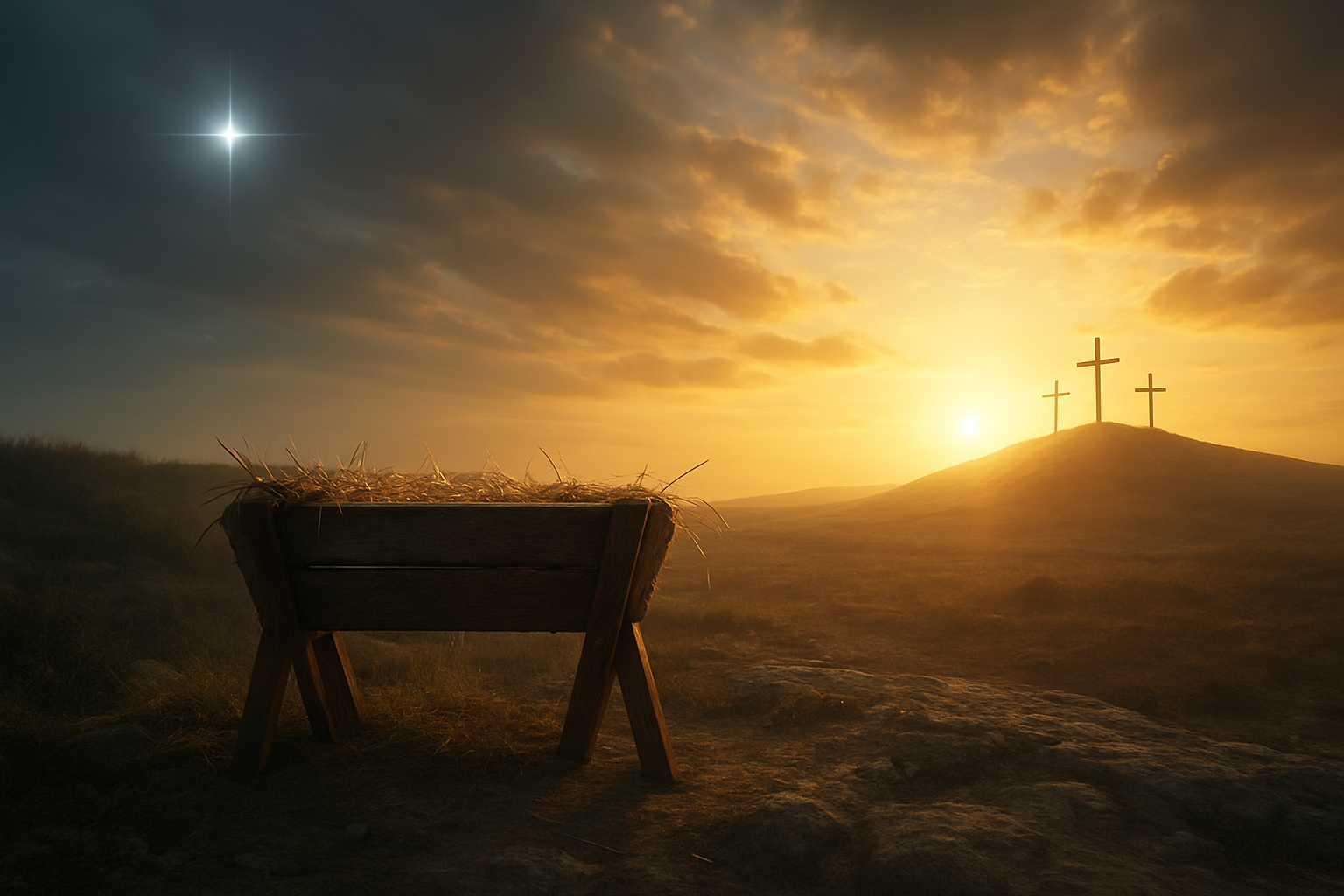
Manger and Cross: Why Jesus Had to Be Born to Die
Hebrews 2:14-15
“Inasmuch then as the children have partaken of flesh and blood, He Himself likewise shared in the same, that through death He might destroy him who had the power of death, that is, the devil, and release those who through fear of death were all their lifetime subject to bondage.”
Manger and Cross: In this final devotional of the Christmas Series, we return to the heart of why Jesus came—seeing how the story that began in the manger leads us all the way to the cross.
The Fullness of Time
When the fullness of time had arrived, Christ came to earth (Galatians 4:4). For centuries, God had been preparing the world for this moment – establishing Israel, sending prophets, making promises, building anticipation. Throughout our journey, we’ve seen how heaven broke silence to announce His coming, how love came down from the Father’s heart, how there was no room in the inn yet room in a stable. Now, on Christmas Day, we must ask the crucial question: Why did Jesus have to come at all?
The answer connects the manger and cross inseparably. Jesus came to earth to take on flesh and blood – mortality itself – to share our humanity with us. The baby in Bethlehem’s stable wasn’t just visiting earth; He was becoming one of us. By taking on our limitations, being born as a son of Adam and as the Son of God, He partook of our struggles, temptations, and mortality. But this wasn’t the goal – it was the means. The manger was necessary because the cross was necessary. Jesus had to become human to die as a human sacrifice for human sin.
The Only Qualified Sacrifice
Here’s the profound truth that unites the manger and cross: In living sinless, Jesus became the only willing, volunteering sacrifice to take on humankind’s sin. Every other human who has ever lived has been disqualified from this role by their own sin (Romans 3:23). We needed a Savior, but we couldn’t produce one from within our own ranks. The one who would save us had to come from outside the contaminated human line.
This is why the virgin birth matters so deeply. Jesus was born of a woman – fully human, sharing our nature, able to represent us. But He was conceived by the Holy Spirit – without inherited sin, perfectly righteous from conception, able to live the sinless life required for an acceptable sacrifice. The manger held the only human who could qualify to die on the cross for others.
And since He was perfect, He was able to take on our sin, and the sacrifice was well-pleasing to God (Ephesians 5:2). No animal sacrifice could accomplish this – they merely covered sin temporarily, pointing forward to the ultimate sacrifice (Hebrews 10:4). No human substitute could accomplish this – we’re all fallen and in need of saving ourselves. Only Jesus – fully God and fully man, sinless yet willing to be “made sin for us” (2 Corinthians 5:21) – could bridge the gap between the holy God and sinful humanity.
The Sufficient Sacrifice
The magnitude of what happened at the cross is almost incomprehensible. Jesus took on the sins of all mankind in one moment of time, and His sacrifice is sufficient for all time (Hebrews 10:10). Every sin – past, present, and future. Every sinner – from Adam to the last person who will ever live. Every transgression against God’s holiness – fully punished in Christ’s body on the tree. The manger led to the cross, and the cross accomplished what nothing else could.
Anyone who receives this gift will have His perfect righteousness attributed forever, which cannot be lost or taken away (Romans 8:38-39). This is the exchange the manger and cross made possible: our sin for His righteousness, our death for His life, our condemnation for His justification. When you trust in Christ, God sees you clothed in Jesus’ perfect righteousness – not your own failed attempts at goodness, but His flawless record credited to your account permanently.
This righteousness cannot be earned, which is why the manger was necessary – we needed a Savior we couldn’t produce ourselves. And this righteousness cannot be lost, which is why the cross was sufficient – Jesus’ sacrifice fully satisfied God’s justice once for all. You don’t maintain your salvation by your performance any more than you earned it by your goodness. Both come entirely from Jesus, whose journey from manger to cross secured your redemption completely.
Breaking the Power of Death
By His perfect sinless sacrifice and resurrection, Jesus once and for all broke the one who had the power over death (Hebrews 2:14). Satan had bound all sinful humankind to death and ruin. From the moment sin entered in Eden, every human born has been under death’s sentence – not just physical death, but spiritual death and eternal separation from God (Romans 6:23). Satan wielded death as his weapon, holding humanity in bondage through fear and futility.
But Jesus conquered sin and death in human form and thus destroyed the power of death. This is why both the manger and cross were necessary. Jesus had to become human (manger) to die as a human (cross) and rise as the firstfruits of resurrection (1 Corinthians 15:20). Death has been swallowed up in victory through Jesus Christ (1 Corinthians 15:54). The grave couldn’t hold Him because He had no sin to keep Him there. And because He rose, everyone united to Him by faith will also rise.
The manger began the victory; the cross accomplished it; the resurrection proved it. Satan’s power is broken. Death’s sting is removed. The fear that held humanity in lifelong bondage has been destroyed for all who trust in Christ. You don’t have to fear death anymore – Jesus went through it and came out the other side, transforming it from an end into a doorway.
Restoration and Reunion
Through Jesus Christ, our fellowship with God is once again restored. This is what the manger and cross accomplished together. Sin had broken the relationship between Creator and creation, between holy God and rebellious humanity. We were alienated, enemies in our minds through wicked works (Colossians 1:21). But through Christ’s incarnation, death, and resurrection, humankind can once more commune with their Creator in perfect harmony.
This isn’t just positional truth about our legal standing – it’s relational reality about our daily experience. Because Jesus took on flesh and blood in the manger and shed that flesh and blood on the cross, you can now approach God’s throne boldly (Hebrews 4:16). You’re not an outsider looking in; you’re a child welcomed home. You’re not a criminal before a judge; you’re a son or daughter before your Father. The fellowship Adam enjoyed with God in Eden before the fall – walking with Him in the cool of the day, communing without barrier – has been restored and will be perfected.
And there’s more. We have a future of a redeemed earth and body, restored to how God has planned (Revelation 21:1-4). The manger and cross didn’t just fix the past; they secured the future. Jesus’ incarnation and sacrifice guarantee that one day, all things will be made new. Your body will be resurrected – perfect, glorious, immortal. The earth will be restored – no more curse, no more decay. Creation will be liberated from its bondage to corruption. And you will dwell with God forever in perfect, unbroken, eternal fellowship.
The Baby Who Came to Die
This Christmas Day, as you celebrate Jesus’ birth, don’t separate the manger from the cross. From the beginning, the manger pointed toward the cross because that was always the plan.
Jesus didn’t come primarily to teach us, heal people, or perform miracles. He came to die – to become the willing, volunteering sacrifice that would break Satan’s power, destroy death’s grip, satisfy God’s justice, secure our righteousness, and restore our fellowship with the Father.
That’s why we celebrate Christmas with such joy. The manger means salvation is possible. The cross means salvation is accomplished. The resurrection means salvation is guaranteed. And the return means salvation will be consummated. From manger to cross to throne – Jesus completed the work He was born to do.
Reflection Questions
- How does understanding that Jesus had to become human to die as a human change the way you view Christmas and His birth in the manger?
- What does it mean to you that Jesus’ sacrifice is “sufficient for all time” and that your righteousness in Him “cannot be lost or taken away”?
- In what ways does death still hold you in bondage through fear? How does Jesus’ victory over death free you from that fear?
- How should the promise of a “redeemed earth and body” and restored fellowship with God affect the way you live today?
Prayer
Consider the journey from manger to cross that Jesus made for you. Thank Him for becoming human to die in your place, for conquering sin and death, and for restoring your fellowship with God forever.
If this devotional encouraged your heart today, would you consider sharing it with someone who could be blessed by it as well? You can also explore more encouragement in the related series below.
Salvation Devotional Series ->
Leave a Reply